
GUIDE: GenAI Units In Digital Design Education
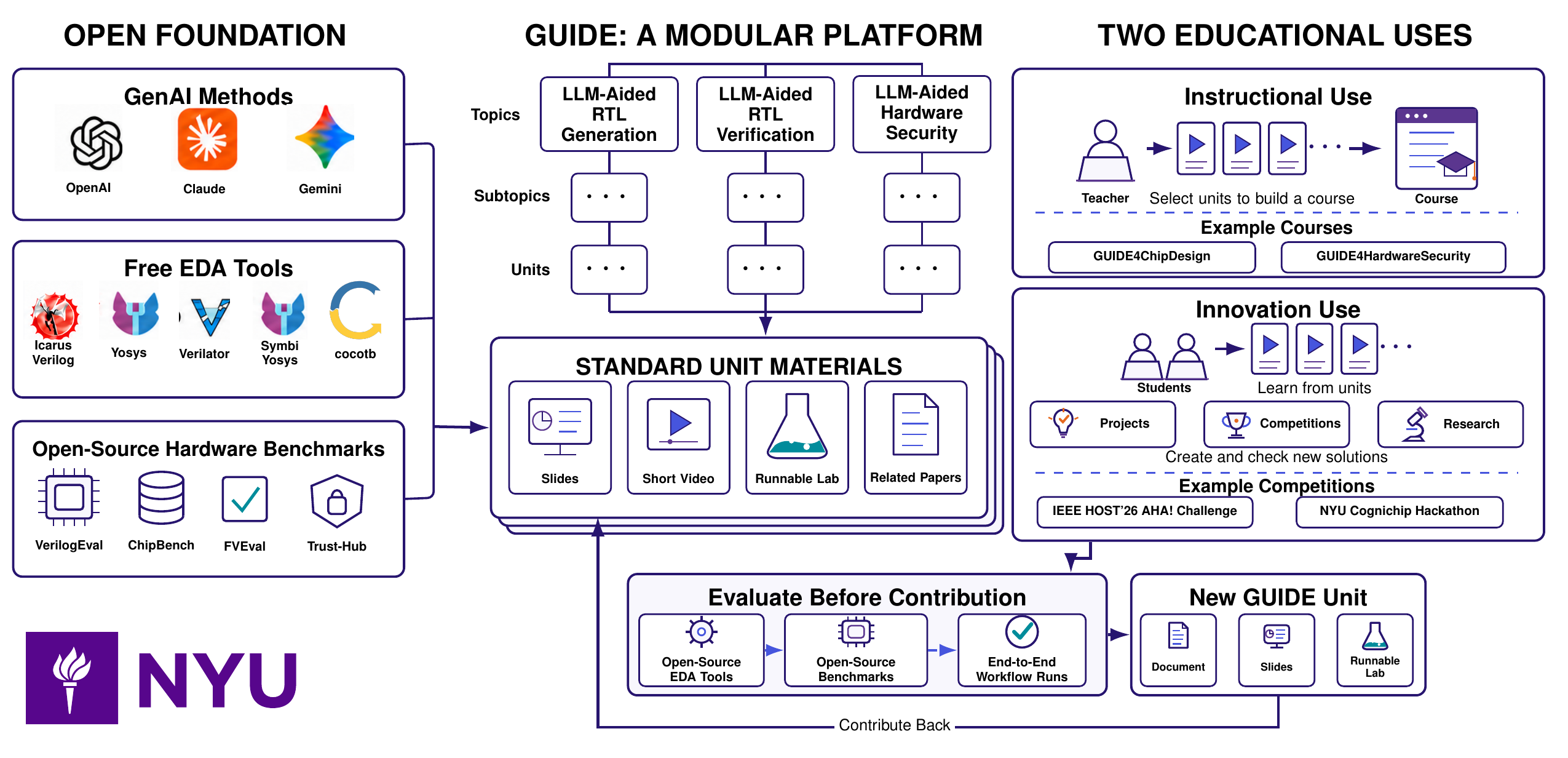
GUIDE is an open, modular platform for teaching and advancing GenAI-driven digital design. It connects generative-AI methods with free electronic design automation tools and open-source hardware benchmarks so that students can generate, analyze, and validate hardware in reproducible end-to-end workflows.
GUIDE was introduced in our DATE 2026 work, Special Day — GUIDE: GenAI Units In Digital Design Education. It is designed for two complementary purposes:
- Instructional Use: instructors select and assemble self-contained units to build courses for different student backgrounds and learning goals.
- Innovation Use: students extend and combine units through projects, competitions, and research, then evaluate their contributions with shared tools and benchmarks.
Why GUIDE?
GenAI-driven digital design education faces three practical challenges:
- Rapid change. New models and design methods appear quickly, so monolithic course materials become outdated.
- End-to-end validation. Generating RTL is not enough; students must compile, simulate, synthesize, formally verify, and analyze the resulting hardware.
- Accessible infrastructure. Commercial EDA licenses can limit reproducibility and access across institutions.
GUIDE addresses these challenges with modular learning units, free EDA tools, open hardware benchmarks, and evidence-based evaluation.
Platform Architecture
GUIDE currently organizes its units into three topics:
- LLM-aided RTL generation
- LLM-aided RTL verification
- LLM-aided hardware security
Each topic contains subtopics and individual teaching units. All units share a standard structure:
- Slides that explain the problem, workflow, inputs and outputs, key ideas, and common pitfalls
- Short video for self-study and review
- Runnable lab that executes end-to-end in Google Colab
- Related papers that connect the activity to current research
The common foundation includes Icarus Verilog, Yosys, Verilator, SymbiYosys, and cocotb, together with benchmarks such as VerilogEval, ChipBench, FVEval, and Trust-Hub.
Teaching-Ready Unit Requirements
Before a unit is added to GUIDE, it should satisfy four requirements:
- Run from a clean environment without private files or commercial licenses
- Complete at least one benchmark-based, end-to-end example
- Produce clear evidence for grading, such as logs, waveforms, reports, or verification results
- Explain the workflow in language accessible to students with different backgrounds
GUIDE-Driven Courses
GUIDE4ChipDesign I — Fall 2025
This 14-week course introduces LLM-aided RTL generation, simulation-based verification, assertion generation, and hardware-security awareness. Twenty-five students completed the course; the final scores averaged 92.9/100, and 80% of the students scored at least 90.
GUIDE4ChipDesign II — Spring 2026
The second course moves from individual units to team-based projects and full implementations, including FPGA deployment. Thirteen two-student teams proposed and developed their own projects using GUIDE-based design, verification, and security workflows.
GUIDE4HardwareSecurity — Spring 2026
This course combines foundational RTL generation with GenAI-assisted hardware attacks and defenses. An offering at Rensselaer Polytechnic Institute enrolled 34 undergraduate and graduate students and used team projects to connect structured learning units with open-ended attack-and-defense workflows.
Projects and Competitions
LLM-Aided Digital Adder Optimization
Students generate, verify, and optimize open-source adder architectures. An LLM iteratively modifies RTL while Yosys returns area and timing feedback. Candidates are accepted only after simulation and equivalence checking.
IEEE HOST 2026 AHA! Challenge
The AI-based Hardware Attacks Challenge used a red-team/blue-team format for GenAI-assisted hardware-Trojan insertion and detection. It registered 122 participants across 53 teams, with eight teams advancing to the final judging round.
NYU Cognichip Hackathon
The hackathon engaged 72 students across 24 teams from the United States, Canada, and India. Teams combined RTL-generation and verification units to build and evaluate their own AI-assisted hardware-design workflows.
Future Directions
Unit Agents
Each GUIDE unit can become the knowledge base for a focused LLM agent. Multiple unit agents can exchange design artifacts and EDA-tool feedback, compare alternatives, and produce a candidate solution package containing a document, slides, and a runnable lab. Human review remains responsible for correctness, reproducibility, and research value.
Closing the Loop to Silicon
GUIDE can extend from GenAI-aided RTL to fabricated chips through open flows such as Tiny Tapeout. Students could package RTL, testbenches, and constraints, generate a layout with an open PDK, and contribute post-silicon results back as a new unit.
Maintaining Reproducibility
Because models and APIs evolve quickly, GUIDE emphasizes versioned environments, provider-independent interfaces, automated lab testing, saved outputs, and pretested alternative models so that learning goals remain stable even as tools change.